Wednesday, July 22, 2026

Kiley Griggs and The College Quest

Kiley is a power wheelchair user, smiles for the camera, underneath a black flag, with gold text that says "PHSC," hanging off the side of a light pole. Kiley has shoulder-length, brunette hair, which hangs loosely. She's wearing a yellow t-shirt, black skinny jeans, and white sneakers. She is uses a Permobil power wheelchair, which has a teal-colored frame.
For many people, attending college is viewed as a rite of passage. From TV shows, to movies, to books, and everything in between, we're inundated with examples of "the college experience." These things try to teach us what we should expect out of our experiences with higher education. It can lead people to believe that there is a "right" or "wrong" way to attend college, which absolutely isn't the case. Who we don't often see are individuals who have trouble accessing higher education. Who we really don't see are the students who attend higher education but, for several reasons, are unable to have that "typical" college experience. In particular, disabled students' access to higher education can be impacted by accessibility needs. Kiley Griggs, who recently graduated from an accelerated STEM-focused high school program, has found herself at these crossroads. We don't often talk about what happens when disabled children grow up, become adults, and want to have the same experiences as their non-disabled peers. What accessibility barriers potentially prevent disabled students from having equal access to resources and activities, such as living in a dormitory, joining a sorority or fraternity, attending Homecoming, or even dating? I sat down with Kiley to learn a bit about her experiences applying to college. We spoke about her past, what she's currently gearing up for, and the pushback that is actively preventing her from participating in higher education, in the way she wants to. Her story is a powerful one, offering us insight into extremely important discussions of disability's relationship with independence, autonomy, and equality.

Kiley is a bright young woman who, I'd argue, is wise beyond her years. Before graduating, she was the only wheelchair user enrolled in Wendell Krinn Technical High School's cybersecurity program. In fact, at the school, Kiley was the only wheelchair user to ever be fully mainstreamed. Already equipped with a few cybersecurity certifications, she graduated with both her high school diploma and her Associate of Arts (AA) degree. To say the least, that's an impressive goal for anybody to accomplish.

Glimpsing into the future, Kiley is considering several options. When I asked about her academic interests, she said, "I like a lot of different things! I like getting my hands dirty in white hat hacking. I like talking to people and interfacing with [them]. I like troubleshooting things. I like making little [creative] projects... So, I don't really know where I'm going to go. Just somewhere in the IT headspace." Currently, she's focusing on programs that focus on the topics of AI, business, and robotics. Her sights are set on a potential Master's and/or law degree.

To maneuver around a university campus, Kiley uses her purple, Permobil power wheelchair. She faces away from the camera, and is shown passing by a light pole. Overhead, a flag hangs off its side. It has a black background. In gold, are the letters "PHSC." Beneath that is a cartoonish-looking bobcat, with the word "Bobcats" written beneath it. To Kiley's right is a dark green bench, which has small holes through both the elongated seat and backrest. Behind her is a tall, white building.

It goes without saying that Kiley has a bright future before her. However, I have to admit: after speaking about her experiences regarding accessibility, I felt a sour taste begin to creep into my mouth. As Kylie begins to tell me about the limitations that she's experiencing, regarding physical accessibility, I have a familiar, sinking feeling. It reminded me of the time I'd spent in Graduate School and the unnecessary amount of difficulty I experienced, regarding accessibility.

Here's the reality: most college students, unless they are disabled, don't have to worry about certain limitations. Here, I'm particularly referring to the ability to live in a university dorm and independently attend class. Only disabled students have to grapple with the worry of finding a caregiver, as well as needing accessibility accommodations, both within and outside of the classroom. Systems like Florida Medicaid or the MedWaiver are intended to provide healthcare and financial assistance for disabled people; however, they also add a lot of restrictions that most are unaware of. Wouldn't you know it? Those restrictions have a huge impact on disabled people, who may want to venture out of state, to attend the college or university of their dreams. Kiley told me, "The way our system is set up, the way our Medicaid is set up, if I leave the state, I lose Medicaid. Even though my teachers are like, 'You could go to Columbia or something!' I'm like, 'No.' [Then they say,] 'But it would be so good for you.' I'm like, 'But I can't do that.'" For Kiley to requalify for financial resources, such as Medicaid, Social Security, and the MedWaiver, she'd have to live in a new state, for a set amount of time. During that time, she'd have no assistance with medically-related expenses. For a disabled person, especially for those of us who have to rely on mobility equipment like power and manual wheelchairs, that waiting period becomes a potential death sentence. To me, all of these factors sound a little too similar to the concept of "Separate but equal." In case you are unfamiliar, that practice is supposed to be illegal. I digress.

So, what does any of this mean for Kiley, as well as her disabled peers? For one, it actively prevents them from having the same kinds of opportunities as non-disabled university students. In fact, it aims to prevent them from becoming university students, at all.

Why is any of this important? To be blunt, I believe that Kylie's struggles are an active infringement upon her rights. When I asked Kylie why it is so important for her to live on her own, she offered, "I just want the independence. For the majority of my youth, I went to camp. Camp is freedom! I get to make my own decisions. I get to be my own human. My parents are really good about stepping back... but they're still my parents. I want freedom. If this makes any sense... [experiencing] that kind of freedom makes you yearn for it even more. I want the independence of living on my own. I want to possibly join a sorority. I want that college experience. I want the fun stuff, on top of the academic stuff."

As I mentioned, Kiley has a few kinds of accessibility needs. For starters, she'll need accommodations both inside and outside the classroom. While some of these accommodations may overlap, a number of them don't. Most people assume that colleges or universities pay for one-on-one aids for disabled students. Actually, they don't. Regarding accessibility accommodations, universities will pay for a scribe, better known as a notetaker. Scribes are a fantastic resource for students like Kiley, who don't have the ability to write by hand. These scribes are only paid for the time that they spend in your class, with you. So, outside of class time, these individuals probably won't be available to help Kiley with other, accessibility needs.

Additionally, since she doesn't have the ability to write and may type slowly on a computer, Kiley will need extended time for test taking. As it is, she's already had to deal with requesting accommodations for taking certification exams. I asked Kiley what it was like to those kinds of tests, to which she replied, "In order for a disabled person to take a certification exam, [and receive accommodations for test taking], they may have to wait for months in advance, apply, wait for [the application] to go through, then it gets denied and we have to jump through hoops. Then, other companies are like, 'Boom! You're approved!' Meanwhile, other people... just have to click the button, click what day they want to take the test, click 'Go,' and they're registered. [Disabled people] have to jump through all these things and get like a voucher code." To Kiley's point, requesting accommodations adds an additional layer of difficulty that disabled test takers must endure, while non-disabled test takers simply need to sign up for the exam. Additionally, if you are disabled and need testing accommodations, a lot of certification or entry exams require disabled students to have a note from a doctor, validating the student's disabilities and limitations. I'm unsure of a more efficient method for speeding up this process; however, as somebody who needed accommodations to take the GRE, in order to attend graduate school, I can tell you that this process may be tedious, lengthy, and stressful.

For individuals like Kiley and myself, even though we need accommodations, requesting them can sometimes feel overwhelming. She relayed to me, "I have a hard time invoking my extended time and asking for extensions, on assignments. Because, in my head, nobody made me feel this way, but it feels like a cop-out or excuse. I know it's not an excuse. I know I need it... I know I work harder but, in my brain, my perfectionist, little gifted brain, it's like, 'Oh! You're giving up!'" As Kiley demonstrates, for disabled students, our differences can sometimes leave us feeling isolated or guilty. Both of us hope that this blog post will help other disabled people to recognize these feelings in themselves, let them know that they're not alone, and that  accessing accessibility accommodations is our civil right.

Kiley is located to the left side of the picture. She drives her pink, Permobil power wheelchair across a smooth, wide, concrete bridge. On either side of her, there are green, metal railings that are the height of the top of Kiley's head. To the right is a lake, which is surrounded by trees, the most prominent of which hangs over the water. In front of Kiley is a long sidewalk that forks to the left and right.

So, what about outside of the classroom? Well, those services would need to be provided by a private caregiver. Kiley will either have to pay for that service, out of pocket, or through another entity like the MedWaiver. If she were to go out of state, as I previously mentioned, she'd be without any disability-focused resources for a period of time. That period differs, depending on the state. So, if Kiley were to try and attend an out-of-state university, she'd have no assistance to help pay for a caregiver, at all, for a set period of time. This could be anywhere from a couple months to upwards of a year. Could you imagine not being able to use the restroom, cook, take a shower, or get dressed, for a year?! It's irrational, ridiculous, and completely unrealistic.

Regarding her life post-graduation, I asked Kylie to tell me why employers should make a more concerted effort to hire disabled workers. She said, "In my case: work ethic. I will get a task done, [through] perseverance and grit. People talk these days about how, 'Oh, Gen. Z has no grit. They're iPad kids... but I have the perseverance. I have the grit. I have the things that some other [people] don't have. I've had to fight for almost everything I have, or everything I wanted to get. In the end, I mean, it stunk to go through, obviously. But [that] will make me a good employee." Kiley's answer rang in my ears for some time, because I've had to fight against the same ideas. Especially regarding the current state of Disability Rights, where average people believe that disabled people want to do nothing, then receive a check in the mail from Social Security (which, I have to point out, is very little money), Kylie's words show that this observation is completely false. Disabled people want to contribute to society. Want to know why we don't see more disabled people, in higher-paying roles? Because it's next to impossible for us to achieve the necessary education, experience, and testing to do so.

The point of Kiley's story is to show people the parts about living, as a disabled person, which people don't typically hear about. Kiley offered, "I'm happy doing the work that I do. I'm happy representing the organizations I represent. They've done a lot for me... I'm happy to be happy, and to have my picture on their websites, [which show me] being happy. But that's not the full story." By being as successful as we are, to most people, disabled people make our lives look easier than they are. The transfers, the mobility devices, the orthotics, the prosthetics, and the well-behaved service animals... all of these resources seem as if they simply appear, out of thin air. In reality, acquiring these vital resources takes a lot of advocating, planning, training, and even maintenance. So, what do all of these resources have in common? They cost money, and a bunch of it, too.

Concluding our interview, I asked Kylie: "If there was one thing you want people to learn from your experiences, what would that be?" Her reply left chills down my spine. She offered, "I want them to know that this is the voice behind the scenes. We keep talking about, 'You see the happy kid.' Or you see all the cool stuff we get to do, and I love it, but there's also stuff we have to fight for. We fight, and we fight, and it gets exhausting. If an able-bodied person reads this, let them see that. If a disabled person reads this, which I hope they do, there is always a way around the thing, the obstacle, the barrier. Whatever thing, there's always a way. That way might require help, but it's OK to get help... Advocate for yourself! If you're planning to go to college, I will try now to make a way for you. Hopefully, I succeed."

Author:
Kyle Romano
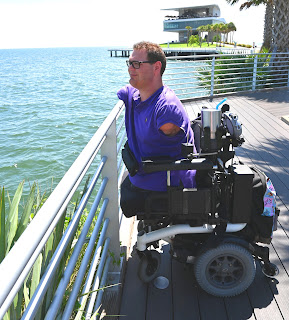
Kyle, in his white-framed, power wheelchair, is wearing a purple Polo shirt. As he looks over the ocean, his right arm is on the railing in front of him. In the background is the St. Petersburg Pier.

Wednesday, May 6, 2026

Wheelchair User Guide: Keeping Cool In The Florida Heat

A female wheelchair user, with long blonde hair and light skin, is situated in front of a grass field. She's wearing plum-colored leggings and a black top. Smiling at the camera, she's wearing sunglasses and is resting her left hand on her wheelchair's joystick. Her wheelchair has a teal frame.

PSA
This blog post isn't sponsored by any company or product. I found all of these items, myself. Given my experience as a quad-amputee, I believe that these items may be particularly useful for disabled people, like myself. These opinions are mine, alone, which aren't reflective of Custom Mobility, or any other entity. Lastly, I'm not a medical professional.

Because of our typically wonderful weather, along with our many beaches and lakes, Florida is a popular vacation destination for both spring and summer. During that time, whether you're disabled or not, the heat impacts everybody. For people with certain disabilities, increased temperatures can have a negative effect on our bodies. Some diagnoses have a more difficult time with thermoregulation, meaning that it's either difficult or impossible for us to regulate our body temperature. In other words, it can be easier for people, with certain diagnoses, to experience both hypothermia (from temperatures that are too low) and hyperthermia (from temperatures that are too high). These diagnoses include, but aren't limited to:

Additionally, there are a variety of medications that impact the body's ability to thermoregulate, including:

  • Anti-psychotics
  • Opioids
  • Anesthetic agents (these include medications that are typically used for surgical or medical procedures)
  • Anticholinergic medications (used to reduce involuntary muscle movements, like spasms, for conditions like COPD and Parkinson's disease)
  • Anti-hypertensive medications (often used to lower high blood pressure)

For everybody, whether you experience disability or not, our lowest body temperatures typically occur around 4:00 a.m., while our highest body temperatures typically occur around 6:00 p.m. If you have a diagnosis that impacts your ability to thermoregulate, it could be a good idea to make plans around these times.

In relation to warmer temperatures, people with the aforementioned disabilities are at a higher risk of heatstroke. A form of hyperthermia, heatstroke can happen when the body's  temperature is greater than 104°F. It can result in a number of problems, prohibiting the function of vital organs, and can include symptoms like dry and hot skin, as well as convulsions, delirium, and/or coma. A person can experience a heatstroke from either over-exerting themselves, or in individuals, who are typically elderly, as well as people with a variety of diagnoses, such as: obesity, diabetes, heart disease, renal disease, hypertension, dementia, and alcoholism.

Lastly, I think it's important to briefly go over the impact of moisture collection, i.e. sweat. To stay combat higher temperatures or physical exertion, our bodies sweat as a way to cool off and prevent instances of hyperthermia. This can impact disabled people in a few, different ways. For people who have the ability to sweat, it's important to engage in pressure relief. Sweat can get trapped between the skin and seat cushions, seat backs, lateral supports, and the list goes on. Without relieving that area of pressure, or giving skin the chance to breath, the trapped moisture can cause skin breakdown, including sores. When individuals don't have the ability to sweat, their bodies lack an important means for cooling down. This limitation can cause people, for example those with SCI, to overheat significantly quicker than usual. Not only is it easier for overheating to occur, but it's also more difficult to bring the bodies temperature back down to a comfortable temperature. 

How Can We Keep Cool During Florida's Spring/Summer Seasons?

Now that I've explained the risks associated with overheating, especially for disabled people, what now? Well, I figure that it's the perfect opportunity to talk about some techniques and products, which can prevent things like hyperthermia, and help you stay cool! 

Before we get started, I want to point out something that's very important: staying hydrated. While this obviously refers to drinking water, it's also important to make sure that your skin is also hydrated. This process can be a balancing act because trapped moisture can cause skin breakdown, especially for skin that isn't exposed to the air. So, please be mindful of that. While we are on the subject of hydration, I found an interesting water bottle, from Dick's Sporting Goods, that you can use for drinking and misting yourself down.

Companies, like Polar Products, have guides for people who have heat intolerant conditions. Sources like this can be a treasure trove of information and, like this blog post, can hopefully send you in the right direction. If you are looking for wearable cooling items, they offer a number of options, including cooling pack vests, water activated vests/accessories, and even higher-end, circulating cold water systems. These products are great for people who don't have an aversion to wearing extra clothing. Also, while some of these items may be lightweight, others may not. Before making a purchase, make sure to check how the added weight could impact your comfort, as well as the way you move your body.

If you're looking for wearable products that cover different parts of your body, there are a few companies that make a variety of cooling accessories. For example, frogg toggs makes a number of different cooling hats, towels, hoodies, bandanas, neck/lower-face coverings, and even face masks. Some of these products also offer UV protection, which can come in handy, in addition to using sunscreen. ergodyne is another company that makes cooling products, like those I mentioned above; however, they seem to make heavier-duty products, including fans, designed for people who work outside. These products can certainly be useful for people with more sensitive, heat intolerant conditions.

Lastly, and briefly, it can be incredibly helpful to have a personal fan. While some are easier to transport or carry around, others are better suited to be placed in a single spot. The advantage of a portable model is pretty obvious, especially if you're an active person, who enjoys the outdoors. I found a variety of misting fans on Amazon, so take a look through them, and maybe you'll find something useful!

The American Academy of Dermatology recommends that everybody use sunscreen that has the strength SPF 30 or higher. So, please make sure to apply it throughout the day. During prolonged exposure to sunlight, it's also very important to protect your eyes. When buying sunglasses, make sure to purchase a pair that promise 100% UV protection. You should look for labels that offer UV protection of at least "400nm." While polarized sunglasses reduce glare, it's important to remember that polarization, alone, won't provide UV protection. 

Hopefully, this information has been helpful to you. If you live here in Florida, or you're planning to visit during the spring/summer, I hope that this blog post has given you some useful information and helpful tips! Stay safe out there, and have a fantastic summer!

Author:
Kyle Romano

 Kyle, in his white-framed, power wheelchair, is wearing a purple Polo shirt. As he looks over the ocean, his right arm is on the railing in front of him. In the background is the St. Petersburg Pier.

Monday, December 8, 2025

Having A Happy and Accessible Holiday Season

Kyle is in a courtyard, in his black power wheelchair, that's facing away from the camera, looking at a large Christmas tree. It is decorated in gold, silver, blue, red, and green, spherical-shaped ornaments. The top of the tree, where Kyle is looking, is decorated with a clear star. The sun is shining through it. Beyond the courtyard are a number of buildings. The sky is overcast.Once again, the holiday season is here! If your family is anything like mine, that means spending a lot of time with parents, siblings, aunts, uncles, cousins, and even friends. If you've ever wondered whether your place is accessible, fear not! Here are some tips to help you plan a holiday party that will be inviting to all of your guests, whether they use mobility equipment or not.

Outside
Since I'm a wheelchair user, I notice things that abled people typically take for granted. For example, some paths and walkways may seem like they're more accessible than they really are. Since they're pretty common, lets use pavers as an example. While they usually look beautiful, pavers and cobblestones can be difficult for wheelchair users to cross.
Grey cobblestones that have green moss, or grass, growing between each piece.Tires, and even some low-hanging parts, can actually get stuck in the cracks between each stone. The front casters of manual wheelchairs tend to catch on these gaps, making them both difficult and dangerous to traverse. Depending on how they're laid, pavers and cobblestones can also make for a pretty bumpy ride, making things more difficult for people who need extra support for their necks and backs.

Gravel, sand, and soft dirt are a wheelchair user's kryptonite. You may not expect it, but most power and manual wheelchairs sink right into pockets of sand. Smooth, concrete sidewalks and walkways are definitely the most accessible for people who use wheelchairs, canes, walkers, scooters, or any other kind of mobility device. 32-inches is usually wide enough to accommodate these devices, and is also the ADA standard for public places like parks.

In a section of grass, there is a short, bright purple sign that features a white, accessibility logo. Written beneath it, also in white, are the words "Step free Route."Lawn parties can be a great way to spend time with your friends and family, but what if you're trying to put together a lawn party that's accessible to people who use mobility devices? While lush, green grass looks beautiful, it may be tough for manual wheelchair users to push themselves through. Unseen dips and holes could also make things tricky for people who are visually impaired or use power wheelchairs, walkers, canes, etc. In my heyday, I was known to flip a chair or two, so I've been on the receiving end of surprise lawn holes. Thick grass can also be tough on the motors of power wheelchairs, causing more wear and tear than usual. If you're worried that your yard may be too lush for it's own good, you can lay down some boards that lead from your house to the area where you'll be hanging out. If you're still concerned, it may be better to host your party indoors, or at least on a patio.

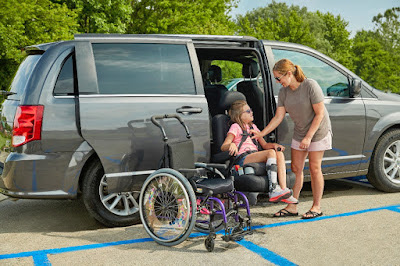
A woman helps her daughter transfer out of their dark gray minivan. Her daughter is seat belted into a transfer seat, which has extended out of the vehicle and closer to the ground. The mother reaches to unfasten the seatbelt. She is wearing a gray top, an off-white skirt, black sandals, sunglasses, and has her blonde hair in a ponytail. Her daughter is wearing a pink shirt, blue shorts, white sneakers, sunglasses, and braces around her shins. They are looking at each other smiling. A purple, manual wheelchair is situated next to the little girl.
When it comes to the parking situation at holiday gatherings, make sure to leave enough room in between each one. 32 inches should be wide enough for wheelchair users to fit between. Accessible vehicles also need about 5-6 feet to safely load/unload a wheelchair or other type of mobility aid. Whether your guest has an accessible van, truck, SUV, or car, please extend a parking courtesy to those who may need it, and make sure that your other guests know.

At the very least, most houses seem to 
have a single step at their front door. For wheelchair users, entryways like this may be difficult to access without a ramp.

Before you do anything, such as buying or building your own ramp, make sure to talk to the party host about your accessibility needs. You may discover that they already have a solution.

In the case that your host does not have an accessibility solution, preparing in advance could save you both a lot of time and frustration. You may need to either bring a ramp that you've purchased, or make your own.

As a word of caution, the Americans with Disabilities Act states that all public ramps should have an incline of no more than 5 degrees. To make sure that you stay safe during your holiday festivities, please keep this in mind. Under no circumstances should anybody remove the anti-tippers/wheelie bars from a wheelchair. If you think that your anti-tippers are preventing you from going up an incline, the angle is too steep. You may either need a longer ramp, or an entirely different solution.

Inside
According to the Americans With Disabilities Act, wheelchair accessible doorways are 32 inches wide, while hallways must be 36 inches wide. It may seem strange that accessible hallways are wider than doors, but wheelchair users need a little extra room to safely turn around. You may also arrange your furniture to follow these guideline.
A picture of Kyle, in front of a Christmas tree, surrounded by his brother, cousins, and grandmother.
Because of their size, certain rooms may be more or less accessible for people who use mobility devices. In particular, restrooms may be difficult for us to navigate. We can't assume that every home will have an accessible restroom, even if that home is owned by one of your family member or a close friends. While ADA standards may call for public facilities to install grab bars, to have raised toilet seats, or to have accessible controls for the sink, personal bathrooms aren't usually furnished this way. As a precaution, measuring the width of the bathroom door is always a great place to start. If you feel that the interior of your own bathroom is a bit cramped, it's OK to communicate that to your guests.

After you've spent some time with your guests and have helped them feel comfortable, to get a better idea for future gatherings, you may want to ask them about the accessibility of your home. You can do this directly by asking questions like, "Do you need help?" or "How can I help you?" If you feel uncomfortable being so direct, consider asking more general questions, such as, "Are you enjoying yourself?" or "Can I get you anything?" The best approach will depend on you and your guests, so try and feel things out before asking.

Like any other party or gathering, the most important part is the food! By arranging entrees, sides, drinks, plates, silverware, etc., at an appropriate height, you'll give wheelchair users the opportunity to serve themselves; however, some of us still may need assistance. Usually, if we need help, we'll ask.

Though it might not seem ideal, in the case that you're house isn't accessible, it is always an option to host the event at a different location. That way, all of your guests feel included. Since the holidays are about enjoying each other's company, let's make this season a fun and accessible one!

Author:
Kyle Romano
Kyle, in his white-framed, power wheelchair, is wearing a purple Polo shirt. As he looks over the ocean, his right arm is on the railing in front of him. In the background is the St. Petersburg Pier.


Tuesday, June 24, 2025

Accessibility Review: Clearwater Aquarium

Accessibility Grade: C

Made famous by the popular film "Dolphin Tale," featuring the late Winter the dolphin, the Clearwater Marine Aquarium is home to a variety of sea life. Focused on rescuing, rehabilitating, and releasing injured animals, this aquarium is a wonderful place to learn, and even teach your kids, about the importance of wildlife conservation. But you're not here to simply read about the animals! You want to know about the facility's accessibility, right? There's a lot to go through, not all of which is sunshine and rainbows. So, let's dive right in! And yes, that pun was totally intended.

To starts things off, even though we couldn't get any pictures, the parking garage was a pretty tight fit. If you have a larger vehicle, I'd proceed with caution. Next to the building's entrance was a pay station, potentially making it easier for wheelchair users to pay; however, upon exiting the garage, you must be able to reach out of your vehicle's window, and feed your ticket into a machine. Since I'm a quad-amputee, I couldn't do this on my own. So, I'm certainly glad that I brought a friend along!

The entrance to the Clearwater Marine Aquarium. Above the door, on wooden planks, is an elegant-looking sign, with the aquarium's name printed in silver. To the left of that is their logo, which is a circle that contains a dolphin tail. It has four holes in the middle, indicating that it is the prosthetic that the late Winter the dolphin used. To the left, above a couple windows, is the quote "Life is too short to be anything but happy." Below that is an advertisement for "Winter the Dolphn's Beach Club."
After navigating the garage, we took an elevator to the main entrance of the Clearwater Marine Aquarium. The wide, automatic doors made the entrance pretty accessible. After getting into the building, we paid the entry fee of $41.95 for an adult ticket. I thought this was pretty pricey, but was slightly OK with that price, only because the aquarium does such great work with animal rehabilitation and conservation. If you'd like some additional information about admission rates, click here to view their website.

An overhead shot of The Ruth & J.O. Stone Dolphin Complex. There are bright orange and green chairs, as well as high-top tables, about ten feet away from the enclosure. Kyle can be seen, in his power wheelchair, looking over the right side of the enclosure, where a group of additional can be seen on the left side of the enclosure.

After taking the elevator, I immediately checked out the Ruth & J.O. Stone Dolphin Complex. From above, you can look over the entire expanse of the dolphin exhibit. From above the water, it wasn't necessarily easy to see the dolphins; however, you can totally see them as they surface to breath. Here, there was plenty of room for people who use mobility equipment. For those who are a bit shorter than I am in my chair, glass makes it possible to see the water within.

A green button, mounted on a gray wall, that has the words "Push to exit," written on it.
When I attempted to go out to the dolphin complex, the automatic door opener didn't work. To the right, you'll see the only button that we could find; however, when we pressed it, nothing happened. There was no other option. So, yet again, I was lucky that I brought a friend who could help me open doors.

Kyle looks over his right shoulder and smiles at the camera. In front of him is a concrete ramp, with aluminum handrails along either side of it. Behind Kyle is a metal sign, with the words "Ruth & J.O. Stone Dolphin Complex" at the top. Below is a layout of the enclosure, showing a layout of the different tanks located within the enclosure.
After taking the elevator down, we found the entrance for the Dolphin Complex's viewing area. The ramp was wide enough to accommodate the width of my wheelchair, though not much more than that. I imagine that this pathway could get congested during busier hours, so please keep that in mind.

A few signs tell visitors about the Dolphin Complex. On the right is a sign titled, "The Window of Wonder," describing the construction of this enclosure. To the left is a sign that shows all of the dolphins that have called the Clearwater Marine Aquarium home. From left to right, the dolphins names are: Nicholas, PJ, Hope, and Winter.
On the way to the Dolphin Complex, you'll find yourself rolling or walking along a corridor. There, you'll see some displays that'll tell you about the different dolphins who have called the Clearwater Marine Aquarium home.


Kyle looks through a window, located on the side of the Dolphin Complex. A bottlenose dolphin is swimming down to the oval-shaped window, to look at Kyle.
Once you get to the big tank, you'll get a chance to watch the dolphins as they swim through their enclosure. Since I was a child, I've always loved marine animals. Getting the opportunity to tend to my inner-child, and have the chance to come face-to-face with a bottlenose dolphin, was a wonderfully nostalgic experience. As we go through the rest of the aquarium, you'll recognize that this part of it is really accessible: the paths are typically pretty wide and are at a good height for wheelchair users to see. I have to point out that this section of the aquarium is much newer than most of the other exhibits. You'll see that this exhibit isn't necessarily reflective of the rest of the aquarium's accessibility, which was lacking in a lot of ways. But we'll get to that in just a second.
Kyle navigates his wheelchair over a black, elevated pad, that has the word "Caution" written in yellow, and yellow lines surrounding it. Beyond him, in the background, is a stingray exhibit. People can be seen looking into the enclosure.


Continuing into the rest of the aquarium, where most of the animals are held, was a little confusing. In the area shown above, you'll see a caution sign, which sits over a large bump. I was actually surprised at how jarring the uneven floor actually was. For wheelchair users, I'd definitely recommend being very careful, and treading over this bump very slowly. This bump is a lot steeper than it looks in the picture.

Kyle is in front of the stingray enclosure, speaking with one of the staff members. Behind him are more visitors and a fake-looking dock, suspended above the water. Some additional staff are up there, talking to each other.
At the stingray enclosure, we met a number of their staff, all of whom were extremely friendly. This area had lower areas, made of glass, so that children can easily see into the tank. For wheelchair users who are a bit short, this exhibit will be a bit easier to see the creatures in the exhibit.

Kyle looks into a tank, at a nurse shark. The window is tiled and low to the ground, making it easier for children to see.
As we meandered through the surrounding exhibits, we actually got a bit lost. Here, we saw some more of the animals that they had on exhibit. Here, there were a number of different sharks, fish, and crustaceans. These enclosures sat pretty low to the ground, making them a bit easier for children and wheelchair users to see into the enclosure. There was also an area that showed their operating rooms, where they treat their sick animals. 

Kyle navigates a narrow walk way, which is barely wide enough for his power wheelchair to fit. To the right is a staircase, and to the left is a black wall. Directly in front of him is a machine for dippin' dots ice cream.
In what appeared to be the old part of the aquarium, it was much more difficult to get around. Firstly, it was really difficult for us to find the elevator. I aimlessly searched for what felt like hours and ended up getting lost. After finally finding the elevator, we took it to see the other, remaining exhibits. To the left, you'll see a picture of me, going through this tiny space, to try and get to the other exhibits. Though my power wheelchair fit, the opening was really narrow. In fact, I didn't think I would even be able to make it through the opening. Additionally, to the right, you can see a staircase. For a child, or somebody who may not have the best driving skills, I feel like this space is honestly dangerous.

As Kyle looks into a large aquarium below, he leans on a railing, placing his left arm on it. To the right of him is a blue sign, which indicates that the spot is reserved for wheelchair access.

Once I made it through that treacherous corridor, I was able to get to some of the other enclosures with relative ease. There are "wheelchair access" signs placed around these exhibits, which I assume is a way to tell visitors that they should leave space for wheelchair users, who may need to get close to the railing to see the exhibit below. I didn't have much trouble seeing over the railing, but I also stand pretty tall (for a wheelchair user, that is!). For people who are a bit shorter, you may experience some difficulty seeing into these exhibits. If you are a power wheelchair user and have a seat elevator, now may be the time to use it.

Kyle parks his wheelchair at the "access" sign for the otter enclosure. Above it is a brightly colored sign that reads "Otter Oasis." To Kyle's left, there are a few groups of people, all leaning on the railing, looking down and into the enclosure.
Similarly, you'll find other, accessible viewing spaces for other exhibits. Located on the opposite end of the room, which we've shown above, is an area that allows visitors to take a peak into their otter exhibit, which is called "Otter Oasis." The wheelchair accessible spot was located at the end of the exhibit, which kind of made it difficult to see the otters below.
Kyle leans on a railing with his right arm, looking out over the boats parked at the Clearwater Aquarium's docks. The water in the channel is calm, and is surrounded by mangrove and palm trees. Behind Kyle is a resting area, in the shade, for vistors to use.

From here, we took a stroll to a patio area, located right outside of the exhibits that I mentioned above.  The view was pretty nice, giving visitors a view of the channel, located behind the aquarium. In the background, you'll see some docks, which have some boats that are on lifts. We learned that the aquarium does offer dolphin tours on their boats; however, we were also told that the tour boats are not wheelchair accessible.

On the right is a single, outdoor chair, made of black wicker,  with blue cushions. To the left is a longer, outdoor couch, of the same color. Above the seat on the right is a sign that says "Quiet Area."

You'll notice that, in the seating area, there is actually a sign, indicating that this space is intended to serve as a quiet area. Because the sign shows a heart with headphones on it, I'll make an assumption that this environment is intended for visitors who are on the autism spectrum. It is pretty secluded from the rest of the aquarium; so, if you or your loved one is on the spectrum, this may be a great place to relax and recharge.

Kyle looks into a large tank, where a tarpon, a few fish, and a sea turtle swims by.
To finish up this review, I want to point out that I have some personal history with the Clearwater aquarium. When I was a little boy, I used to go there for Occupational Therapy. I helped them to prepare the animals' food, feed them, and got the chance to even do some animal enrichment. It has and will always be special to me. That said, the accessibility of the Clearwater Aquarium, which is actually the purpose of this review, was lack luster at best. As I mentioned previously, it wasn't the easiest to navigate. Between two of us, we still got lost on the bottom floor, in the older part of the aquarium. The parking garage wasn't very easy to get around, either. Like I also pointed out: I couldn't have gotten in or out of the garage without assistance. Even though there was supposed to be an automatic door going to the Dolphin Complex, that wasn't working. Finding the elevator, to access the lower part of that exhibit, was also pretty difficult. Actually, I'll just come out and say it: none of the elevators were easy to find. In addition to these shortcomings, there were two areas, which I mentioned above, that I'd consider to be a safety concern for wheelchair users and those who use mobility equipment:. Firstly, I need to address the raised floor, with the caution sign, in the area leading to the stingray exhibit. Another concerning area was the tiny space, which was barely wide enough for my wheelchair to fit through, that was also located right next to an open staircase. If somebody was having difficulty fitting through this small opening, and were to accidentally over-correct their steering, they could potentially fall down the stairs. That would be catastrophic. So, even though I love the animals, and even though I love that the Clearwater Aquarium rehabs sick and injured animals, their accessibility left a lot to be desired. The only reason why I can kind of justify paying $41.95 for an adult ticket, is because that money goes to the care of the animals. I didn't point it out before, so I'll mention that a ticket costs $32.95 for kids (ages 3-11) and $39.95 for seniors (ages 65+). Otherwise, the price point may not be financially accessible for some families. Click here for more information about ticket prices. In the future, I truly hope that some of these accessibility issues will be resolved.


Author: Kyle Romano
Kyle is wearing a seafoam, button down shirt. He is wearing black-rimmed glasses and has short, brown hair.


Photographer: Luis Rodriguez

Tuesday, May 20, 2025

Gavin Lambert: Find The Good


Gavin is corner turned, facing the camera, smiling. He has short, dirty blonde hair, and is wearing a blue, athletic collared shirt. Behind him is a counter. Above it, on the wall, is a sign that reads: "Pasco County Florida. Open spaces, vibrant places. Integrity, respect, service excellence, innovation
Judy Heumann, Dr. Martin Luther King Jr., and Rosa Parks were all incredible activists of their time. Even though their struggles were different, they were all fighting for a common goal: they pushed for equality and refused to take "no" for an answer. They didn't just happen to become activists, either. From the very start, what motivated each of them was a single idea, a dream of a world that honored their inalienable rights, regardless of who they were. Gavin Lambert personifies these ideals. Currently a student at Pasco-Hernando State College, Gavin is seeking a degree in Sports Management. Like most students, he has to take courses that may or may not align with his Major. Enter his Entrepreneur Business class. He and his classmates were assigned a project, in which they were instructed to find a real problem in the world, then to find a potential solution to fix that problem.

Gavin sits at a table with his brother, dad, and mom. They are all wearing shirts that are different shades of green. There are tortilla chips and drinks on the table, as well as a decoration that looks like a leprechaun's hat. There are additional St. Patrick's Day decorations, hanging from a mantlepiece. In the background, there are two, additional tables that are both filled with people.

To anybody who knows Gavin, it's no secret that the man's favorite thing to do is go out to eat; however, he also knows that a lot of restaurants aren't that accessible. It's this drive that gave Gavin a grand idea. It was in his Entrepreneur class that Gavin made the connection, and when he decided to actually start questioning the accessibility of the world around him. Naturally, that led him to explore the wheelchair accessibility of local restaurants.

Gavin is in a legislative hearing room, in the Capitol building in Tallahassee. He sits in his manual wheelchair, at a beautiful, carved, wooden podium, in front of a panel of legislators.

Even though it wasn't directly related to Gavin's Major, taking the aforementioned entrepreneur class has changed his life. At the time that I conducted Gavin's interview, this idea was only three weeks old. Within that time, Gavin took what he learned from his school project, and was encouraged to reach out to his local legislators about restaurant accessibility.


At the forefront of Gavin's argument, is that everybody should have the availability to enjoy themselves, in a safe and accessible environment. He knows that he's far from the only disabled person who enjoys going out to eat. For many of us who rely on others for accessible transportation, this need is even more dire, especially if we are only able to get out of the house once-a-month or so. He told me,
"I feel like restaurants are somewhere, where anyone can go, and they can sit there and talk to people... and there's a lot of social value... especially for disabled people who aren't going to school, going to work, or [are] out in the world. And, most people with disabilities, if that is their one outing, they need to be able to have [access] to that." 
Gavin and his mom, Dawn, are eating at an outside table. They are both leaning in, over the table and their food, smiling at the camera. Gavin is wearing a navy-colored tshirt, and Dawn is wearing a white and gray striped shirt.
Here, Gavin is touching on something very important about the lives of disabled people, especially for those of us who rely on government assistance to survive. As a quad-amputee and power wheelchair user, Gavin's cause is near and dear to my heart. The reality is this: disabled people have little-to-no help for anything not directly related to the medical aspect of our lives. Typical, abled people don't think twice about going to dinner with their friends, grabbing a drink, meeting for a pickup game of basketball, etc. People assume that disabled people have equal access to recreational activity, that we have the innate ability to simply enjoy ourselves. The reality is that most of us don't have access to transportation or money, in order to be able to simply meet our friends/family at a restaurant for dinner. Let me try and put it in perspective. Could you imagine if you only left your house/apartment when you needed to go to the doctor, get your car fixed, or pick up groceries? How quick would life become a dreary mess? I'd venture to guess that it would happen rather quickly.

Representative Adam Anderson is shown on the left side of the picture, wearing a navy sports jacket, putting his arm around Gavin's shoulder.
Armed with this knowledge, as well as his own lived experiences, Gavin put his money where his mouth was: he reached out to his local legislators. If nobody was going to do something, he'd take it upon himself to be the change he needed. Gavin first spoke with Pasco County Commissioner, Lisa Yeager, about his plight. From there, he was invited by Representative Adam Anderson to speak at the Capitol in Tallahassee, albeit for a separate issue. While there, Gavin advocated for the passage of House Bill 907, which has since passed. As a result, the Florida Institute for Pediatric Rare Diseases was created. This institute will be huge for families with children, who have been diagnosed with rare diseases. It would include coverage for people with Friedreich's ataxia, which is what Gavin is diagnosed with. The goal is to, "...improve the quality of life and health outcomes for children and families affected by rare diseases by advancing knowledge, diagnosis, and treatment of pediatric rare diseases through research, clinical care, and advocacy." If you'd like to read the Bill in its entirety, click here.

So, where do we go from here? I think that we take Gavin's story, look at what he's accomplished so far, and remain hopeful that his actions, as well as the actions of other Disability Rights activists, pave the way for a more accessible future. I hope that Gavin's work continues to bear fruit, that he inspires you to take action, fighting for what you believe in.

Author:
Kyle Romano
Kyle is leaning on a railing, with his right arm, looking over the ocean. He's wearing a purple Polo shirt, and has a white, power wheelchair. In the background is the St. Petersburg Pier

Tuesday, April 1, 2025

Accessibility Review: Great Explorations - Great Connections

The exhibit hall of Great Explorations is bustling with activity, from kids and their parents. On the right is a treehouse with a yellow slide, which a child is exiting. To the left of that is a Lego table. Beyond that are a number of other exhibits. In the top-left corner of the picture is the Great Explorations logo.
Accessibility Grade:
A+

Back in April of 2023, we did an Accessibility Review for a local children's Museum called Great Explorations. If you'd like to read our initial thoughts, click or tap here to read that post. Our initial impression of the museum's accessibility was very positive! Naturally, when we learned that Great Explorations hosts a regular, sensory-friendly event for children on the autism spectrum, we had to check it out. So, let's take a look at their "Great Connections" event, discuss the intentions behind it, and then give our thoughts on the whole thing.

Started in 2015, Great Connections is a family-friendly, monthly program that's trailered to children with disabilities. It takes place on the weekend of the second Sunday, of each month. Additionally, it is free to families and their children with disabilities.

A purple backpack. Stitched on it is the Great Explorations logo. Beneath it are the words: "sensory backpack."
What is the difference between the typical Great Explorations programs and Great Connections? During this event, the museum closes its doors to the general public, and provides a cool down room for children on the autism spectrum, who may need to take a break from activities and additional stimuli. To make things more inviting for children with sensory issues, lights are dimmed and music is turned off. Additionally, sensory backpacks are available for check out at Guest Services. Although  the museum is happy to lend out their own sensory devices, it's encouraged for you to bring your own sensory support items, from home, to ensure that your child feels as safe and comfortable as possible.

The lobby of Great Explorations. Kyle and Bella are at the back of the room, in front of a wall that is filled with a number of animal enclosures. There are  two tables set up in the room, with purple table cloths. On the table are a few sensory toys. On the floor, there is a blue yoga mat and a few bean bag chairs.

When you enter Great Explorations, their lobby is very spacious. There were two tables set up, which had a number of sensory toys on and around them. If your kiddos like to color, there are crayons and coloring sheets available. On the back wall, there are a series of reptile enclosures.

Leo, the bearded dragon. He is a tan color, matching the color of the rock that he is sitting on. His front legs are resting on a rock, which is a higher elevation than his hind legs, giving the illusion that he's sitting. He is looking sideways, into the camera.
Their Living Collection is home to a variety of reptiles, including fan favorites: Candy Corn, the albino corn snake, and Leo, the famous bearded dragon. There are a number of other animals, such as leopard geckos (Charmander was my personal favorite, because I'm a huge Pokémon fan), turtles, as well as a few more snakes and lizards. If your kiddo is fascinated by reptiles, they'll have so much fun looking at the Living Collection.

A map of the Great Explorations exhibit hall. At the bottom of the map is a key, which shows a list of color-coded symbols, where each color indicates a different kind of sensory aversion. A green lightbulb indicates bright lights; a blue circle, featuring a two stick figures, indicates restrooms; a yellow puzzle piece indicates a cool-down area; an orange droplet indicates a messy area; a red, walking stick figure indicates big movements; and a purple ear indicates areas that have loud sounds.
The gallery features a wide range exhibits, which may be too noisy or bright for some children on the spectrum. To help your child have the most fun possible, Great Explorations has a color-coded guide. On it, you'll find a map of the exhibit layout, including sensory-related information. This resource is a wonderful tool, helping guide you and your child to the most enjoyable exhibits, and away from the ones that they would have aversions towards.

When you enter the exhibit hall, children have access to all of the exhibits that are typically available. Even though we've outlined these in our previous Accessibility Review, it's worth going over some of them again, including new exhibits and any changes made to existing ones. Note that, during the Great Connections event, many of the lights in the building will automatically be dimmed. Additionally, to protect the safety of children with sensory aversions, some of the noisiest exhibits will either be silenced, have their lights dimmed, or may even be turned off.

Bella shows Kyle around the exhibit "My First Market," modeled after a Publix supermarket. There are areas for different types of food, including a produce section, baked goods, etc. On the left, there is a green arrow that says "Checkout," which points to two registers, featuring red cash registers.
My First Market is a mock supermarket, modeled after and sponsored by Publix supermarket. Here, kids can have the chance to shop around for fake produce, meat, seafood, baked goods, and more. There are shopping carts available, and even cash registers at the checkout counters!

Bella makes a fake sandwich, using ingredients made out of a soft, inedible material. In the picture, she has laid out a loaf of bread, and placed onion, tomato, and lettuce on it. We see her placing a square of cheese onto the sandwich.
Another interesting part of the exhibit, which we weren't able to feature in our first Accessibility Review, is a  sandwich station. Here, children can make their own sandwiches (which are not edible), choosing from a number of fake ingredients. These were all hand-sewn, and are really soft to the touch.

Bella is holding a purple and pink tie dye stegosaurus, with white, sparkly spikes. Bella holds the dinosaur stuffed animal, which has yet to be filled with stuffing. Next to them are a few, other kinds of stuffed animals, separated into different cubbies.
The next exhibit that we visited is called the Steam Station. While it can be a great place to showcase different types of demonstrations and performances, we were most interested in their stuffed animal maker. Here, a Great Explorations team member can assist you and your child, making their very own stuffed animal! There were a number of different options to choose from, but this sparkly stegosaurus caught me eye.
Bella lays on their back, in the center of the fake lagoon, arms outstretched as they smile. Their head is resting on one of the pillows, shaped like lily pads. There are additional lily pad pillows strewn around them.
Bella guided us to the next exhibit, called "Tiny Explorers Lagoon." In addition to the farmed-themed activity wall, which we showed off in the previous review, this area also features a fake lagoon that feels like laying on a water bed. There are soft pillows, in the shape of lily pads, for kids to play with, as they pretend to swim. This area is typically great for kids on the spectrum, as it offers a variety of different textures and sensations for them to explore, in a way that feels safe for them.

As with our previous Accessibility Review, Great Explorations lived up to our expectations. Overall, we love what this museum stands for, and believe that their Great Connections program is a great resource for families who have children with disabilities. Whether your kiddo is on the spectrum or not, I'd highly encourage you to check out this spectacular event!

And a special thanks to Bella Perkins, Development Specialist and Sensory Programs Lead, for giving us an incredible tour!

Author: Kyle Romano


Photographer: Luis Rodriguez

Kiley Griggs and The College Quest

For many people, attending college is viewed as a rite of passage. F rom TV shows, to movies, to books, and everything in between, w e'r...